

What State Surveys Can Tell You About an Assisted Living or Memory Care Community in Montana

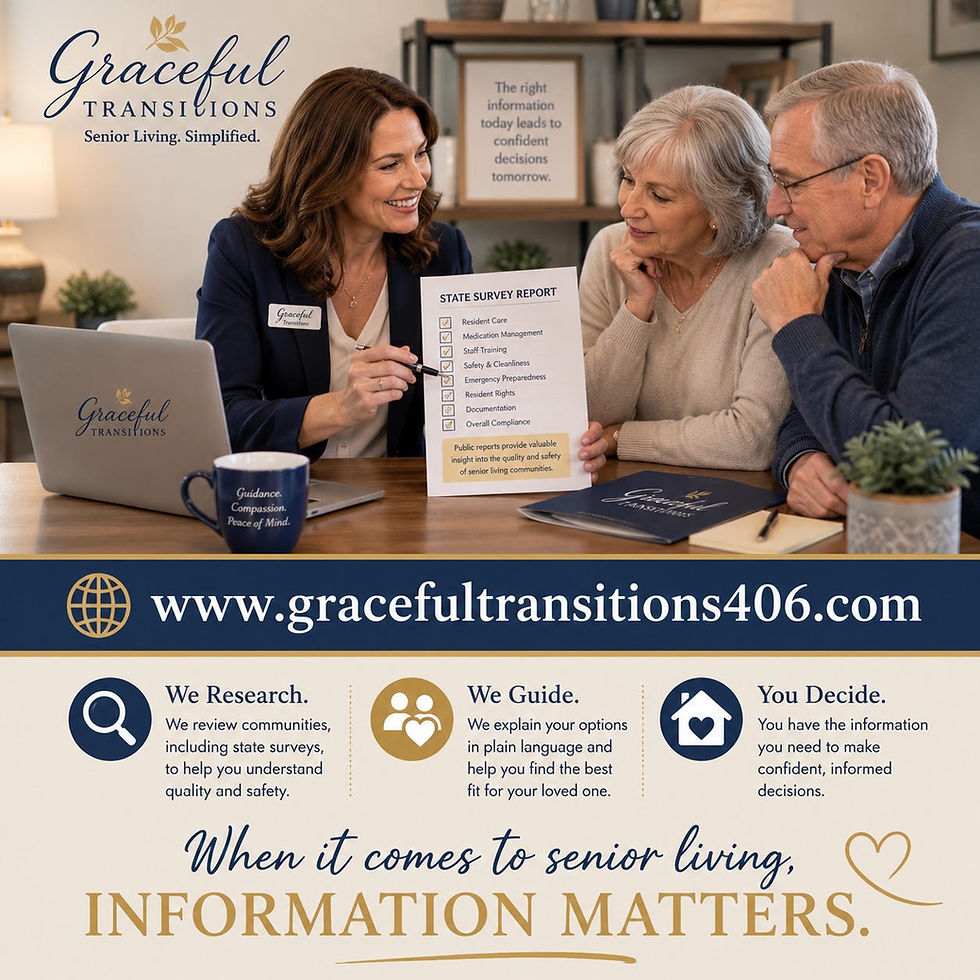
What if one of the most valuable tools for choosing assisted living or memory care wasn't the tour—but a public report most families never know exists?
When families begin searching for assisted living in Montana or memory care in Montana, it's easy to focus on the things they can immediately see.
Beautiful buildings, welcoming staff, attractive dining rooms, and busy activity calendars all create a wonderful first impression.
Those things certainly matter.
But they don't always tell the whole story.
A one-hour tour shows you what a community wants you to see that day. A state survey provides insight into how the community has performed over time.
Unfortunately, many families don't know these reports exist—or they aren't sure how to interpret what they find.
At Graceful Transitions, reviewing state survey reports is one of the many ways we help families make informed decisions when comparing assisted living and memory care communities across Montana.
What Is a State Survey?
Licensed assisted living and memory care communities in Montana are inspected by the Montana Department of Public Health and Human Services (DPHHS).
During these inspections, trained surveyors evaluate whether a community is meeting state licensing requirements designed to protect residents and promote quality care.
Surveyors may review areas such as:
Resident care
Medication management
Staff training
Resident rights
Infection prevention
Emergency preparedness
Food service
Documentation
Building safety
Overall regulatory compliance
After an inspection, the state publishes its findings.
If inspectors identify areas that do not meet state requirements, those issues are documented as deficiencies. If a community is meeting state requirements, that is reflected in the report as well.
These reports are public and available for anyone to review.
Unfortunately, many families don't discover these reports until after they've already selected a community.
Does a Deficiency Mean a Community Is Bad?
Not necessarily.
This is one of the biggest misconceptions families have when reviewing state surveys.
A deficiency does not automatically mean a community provides poor care.
Some deficiencies involve documentation or administrative processes that may have little direct impact on residents. Others involve more significant concerns related to medication management, resident safety, staffing, or resident rights.
The important thing isn't simply counting how many deficiencies a community has.
The real value comes from understanding the bigger picture.
Looking for Patterns, Not Perfection
No community is perfect.
When reviewing state surveys, families should look beyond a single finding and ask questions such as:
Are the same issues appearing year after year?
Were deficiencies corrected promptly?
Are there repeated concerns involving medication management?
Do staffing-related issues continue over multiple inspections?
Does the community demonstrate a commitment to continuous improvement?
Looking at several years of survey history often provides a much clearer picture than reviewing a single inspection.
Think of it this way.
One low grade on a student's report card probably isn't cause for concern.
Several years of struggling in the same subject may indicate a larger issue.
State surveys work much the same way.
Why Families Should Review State Surveys
When families tour an assisted living or memory care community, the experience is naturally designed to make a positive first impression.
You'll likely see welcoming staff, clean common areas, activities in progress, and residents enjoying their day.
Those experiences are important.
But they represent only one moment in time.
State survey reports provide another perspective by documenting observations made during official inspections.
When combined with a personal tour, conversations with staff, online reviews, and an understanding of your loved one's individual needs, state surveys become an important piece of the decision-making process.
Five Survey Findings Families Should Pay Close Attention To
Not every deficiency carries the same level of concern.
Families should pay closer attention to findings that may directly affect resident safety, quality of care, or daily well-being.
1. Medication Management Concerns
Medication management is one of the most important areas reviewed during inspections.
Look for findings involving:
Medication errors
Missed medications
Improper storage
Incomplete documentation
Repeated medication-related deficiencies
A single medication issue doesn't automatically mean a community provides poor care.
However, repeated concerns deserve a closer look.
Ask:
"Can you explain what happened, and what changes were made to prevent it from happening again?"
2. Resident Safety and Fall Concerns
Falls are one of the most common risks among older adults.
Survey findings may identify concerns related to:
Unsafe environments
Inadequate supervision
Failure to follow care plans
Delayed response after incidents
The important question isn't whether a community has ever had a fall.
Falls can happen in any senior living community.
The question is whether the community responds appropriately, learns from the incident, and implements improvements.
3. Staffing and Training Issues
Quality care depends on well-trained staff who understand each resident's needs.
Families should pay attention to findings involving:
Staff training
Failure to follow care procedures
Staffing-related concerns
Staff competency
High turnover
Instead of simply asking, "How many employees work here?"
Ask:
"How do you ensure residents consistently receive the care and attention they need?"
4. Resident Rights Concerns
Every resident deserves dignity, respect, privacy, and the ability to make personal choices whenever possible.
Survey findings involving resident rights may include concerns related to:
Respectful treatment
Privacy
Communication
Personal preferences
Protection of resident rights
These findings deserve careful attention because they reflect the daily experience of residents.
5. Repeated Deficiencies
Perhaps the most important thing families can look for is a pattern.
A community that identifies a problem, corrects it, and improves demonstrates accountability.
A community with the same concerns appearing repeatedly over several years deserves additional questions.
Questions Families Should Ask After Reviewing a Survey
State survey reports should never be viewed as a simple pass-or-fail grade.
Instead, they should become the starting point for a conversation.
Consider asking:
Can you explain this finding?
What was done to correct it?
Has this issue happened before?
What systems are now in place to prevent it from happening again?
How does leadership monitor quality and resident safety?
Often, a community's willingness to openly discuss deficiencies says just as much as the deficiency itself.
Common Mistakes Families Make When Reading Surveys
Looking Only at the Number of Deficiencies
A community with several minor deficiencies may actually provide better care than one with a single serious or repeated violation.
Context matters.
Assuming Zero Deficiencies Means Perfect Care
A survey represents one inspection at one point in time.
Families should also evaluate staffing, communication, activities, resident satisfaction, leadership, and whether the community is the best fit for their loved one's needs.
Ignoring Patterns Over Time
Repeated concerns deserve attention.
Looking at several years of reports often reveals trends that a single inspection cannot.
How Graceful Transitions Uses State Surveys
At Graceful Transitions, we believe Montana families deserve as much information as possible before making one of life's biggest decisions.
As part of our research process, we review publicly available state survey reports alongside many other factors when helping families compare assisted living and memory care communities throughout Montana.
We don't simply count deficiencies.
We look for trends.
We help families understand what the reports mean.
Most importantly, we explain how survey findings fit into the larger picture of choosing the right community for each individual's needs.
State surveys are only one piece of the puzzle, but they often provide valuable insight that families may never discover during a tour alone.
Choosing Senior Living Means Looking Beyond First Impressions
Choosing assisted living or memory care is one of the most important decisions a family will ever make.
While beautiful buildings and friendly staff are important, they should never be the only factors considered.
State survey reports offer another valuable source of information that can help families ask better questions, recognize patterns, and make more confident decisions.
At Graceful Transitions, our mission is to help Montana families navigate the senior living journey with knowledge, compassion, and confidence.
Our services are completely free to families, and we're committed to helping you compare assisted living and memory care communities based on your loved one's unique needs—not just first impressions.
If you have questions about assisted living in Montana, memory care in Montana, or understanding state survey reports, we're here to help


Comments